

Reviewed by Bathroom Republic's Team
Quick answer: Want a softer, rounded look? Go P-shaped. Want a squared, consistent shower footprint? Go L-shaped. Everything else about the two is the same.
If you're planning a bathroom with a bath-and-shower combination, you've probably come across two shapes that look similar at first glance but fit rooms differently: the P-shaped bath and the L-shaped bath. At Bathroom Republic, we stock both across a range of sizes and finishes, and the question we hear most is simply: what's actually different between them? Both give you a full bath at one end and a wider showering area at the other — the difference is in exactly how that wider end is shaped, and that has a real effect on how much room you have to move around in the shower.
What Is a P-Shaped Bath?

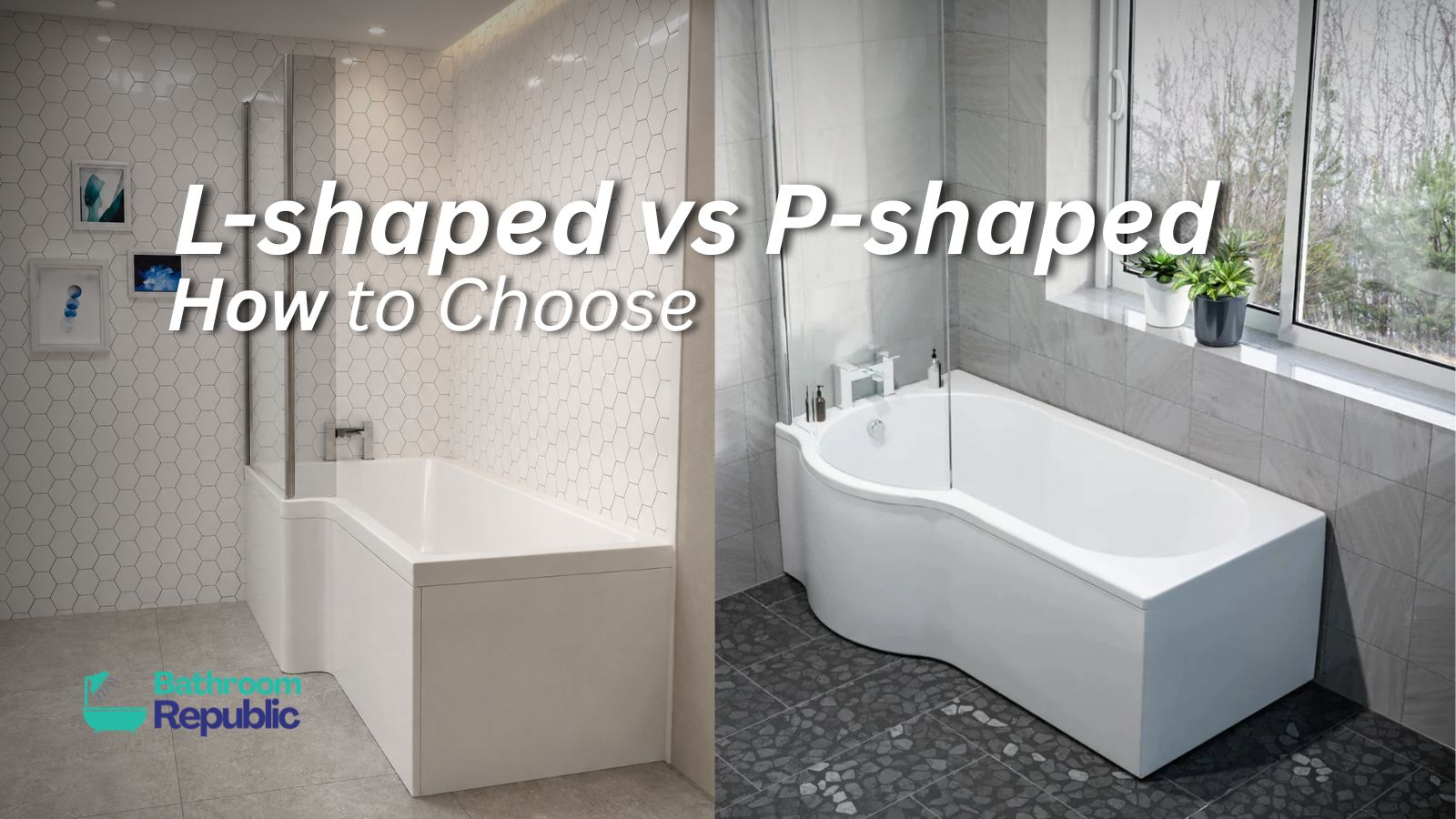
A P-shaped bath gets its name from its outline — a standard rectangular bath at one end, curving out into a rounded, bulb-like shape at the other. That curve is what creates the shower area, giving you a distinctly rounded showering space rather than a squared-off one. Because the curve tapers, the shower footprint is slightly smaller at the top than a straight-sided shape, but the rounded edge is often seen as a softer, more contemporary look.
Browse Bathroom Republic's P-shaped bath suites to compare finishes and sizes.
What Is an L-Shaped Bath?

An L-shaped bath, as the name suggests, follows a more angular outline — the wider showering end is squared off rather than curved, giving the bath a more geometric, right-angled profile. The straight sides mean the shower space keeps its full width from top to bottom, rather than tapering.
Browse Bathroom Republic's L-shaped bath suites to compare finishes and sizes.
The Main Difference — Curved End vs Square End
That's really the core distinction: curved end (P-shaped) vs squared end (L-shaped). Both combine a bath and shower area, but their usable shower space, screen compatibility, installation requirements and appearance can differ by model. It comes down to which shape you'd rather look at, and which shower footprint suits how you actually stand and move while showering.
Simplified layout — actual dimensions vary by model
Which Shape Gives You More Shower Space?
Because an L-shaped bath keeps its straight sides all the way down, it generally gives you a more consistent, squared-off shower area — useful if you want to fit a shower screen with a flat run rather than a curved one, or if you simply prefer more predictable elbow room. A P-shaped bath's curve narrows gradually, so the usable shower footprint tapers slightly compared to an L-shape of the same overall length.
Neither is objectively bigger — the difference is in the shape of the space, not the total room. If you want the shower end to feel as square and consistent as your bath end, L-shaped is the more literal match. If you prefer a rounded, less angular look, P-shaped delivers that without sacrificing much practical space.
Left-Hand vs Right-Hand — What Does That Mean?
Both shapes come in left-hand and right-hand versions. This refers to which end the wider shower section sits on when you're facing the bath — left-hand means the shower end is on your left, right-hand means it's on your right. This matters for plumbing (where your waste and taps need to connect) and for how the bath fits against your existing walls, so it's worth measuring your room and checking which orientation your plumbing already supports before choosing. If you're also replacing fittings, browse bath taps matched to your chosen orientation.
Which Suits a Small Bathroom or En-Suite?
Both shapes work in smaller rooms since they're designed to combine a full bath and shower into one footprint rather than needing separate fixtures. If space is genuinely tight, it's worth comparing against Bathroom Republic's compact and small bathroom suites as well, since suite depth and shower-end width vary by specific model — check the dimensions on the individual product page rather than assuming from the shape alone.
Screens, Panels and What's Included
On our range at Bathroom Republic, bath screens are typically included as part of the suite, but front and end bath panels are usually sold separately — worth checking on each specific product listing, since this can vary between individual suites.
How to Decide: A Quick Checklist
Installation Considerations
Whichever shape you choose, a few general points are worth discussing with whoever fits the bath: both shapes need a level floor and a proper leg set for support; the waste position needs confirming against your existing plumbing before you order; and the shower screen needs a clean silicone seal regardless of shape to avoid leaks at the join. These aren't shape-specific issues — they apply to any shower bath — but they're easy to overlook when comparing two options side by side.
P-Shaped vs L-Shaped: Quick Comparison
Frequently Asked Questions
Is a P-shaped or L-shaped bath easier to fit a shower screen to?
Both take a shower screen designed for their specific shape — an L-shaped bath's straight sides suit a flat-panel screen, while a P-shaped bath needs a curved screen to match its rounded end. Screens are matched to the bath shape, so this isn't really a difficulty difference, just a matching one.
Can I put a P-shaped bath where an L-shaped one was, or vice versa?
Not directly — the shower-end shape is different, so your existing screen, and possibly your tiling around the curve or corner, won't match the new shape. Treat a shape swap as part of a fuller bathroom refit rather than a straight replacement.
Do P-shaped and L-shaped baths cost different amounts?
Price depends on the specific suite, finish, and included fittings rather than the shape itself — compare individual listings rather than assuming one shape costs more than the other.
Which shape is easier to clean?
Both are straightforward to keep clean since they're made from the same materials. The main practical difference is that a squared L-shaped corner has a sharper internal angle where grime can collect if not sealed well, while a P-shaped curve has no hard corner in that spot — but neither is dramatically harder to maintain.
Can I add a shower over either bath shape without a full suite?
Yes — both P-shaped and L-shaped baths are designed with the shower end built in, so you don't need a separate shower enclosure. You just need a compatible screen and shower valve or set for that end.
Do I need professional installation for either shape?
Both shapes are typically fitted by a qualified plumber or bathroom fitter, the same as any bath. The shape itself doesn't add extra complexity, though getting the waste position and leg support right matters for either one.
Ready to choose your shape?
Have you shopped with Bathroom Republic?
We would love to hear about your experience. Your feedback helps us improve and helps other customers make informed choices.
Review Bathroom Republic on TrustpilotAuthor: Bathroom Republic's Team